As an Amazon Associate I earn from qualifying purchases. This page may contain affiliate links.
The best lures for trout fishing are the ones that match what trout are eating, how clear the water is, and how deep they’re holding. This guide walks you through the main lure categories, shows you how to choose between them for streams, lakes and tailwaters, and gives you a short list of budget-friendly options that work well across the season. By the end, you’ll know exactly what to put in your box and how to fish it.
Start With the Water and the Season
Before you buy a single lure, look at where you’re fishing. Trout in a small mountain creek behave differently than trout in a stocked lake or a big tailwater below a dam. Water clarity, temperature and flow decide which lure profiles get noticed. Clear, cold water favors natural colors and subtle movement. Stained or high water calls for bright colors, more vibration and a bigger profile.
Shopping for one? See our guide: 5 Best Bass Assassin Fishing Lures for Bass Anglers (2026).
Season matters just as much. Trout feed heavily on insects in spring and fall, shift toward baitfish-sized meals in summer when they move deeper, and get more aggressive in the cooler months. A lure that fails in July may outfish everything else in April.
Quick water and season checklist
- Clear water and bright sun: use natural colors, smaller sizes and slower retrieves.
- Stained or high water: go with chartreuse, gold or white, and fish a little faster.
- Cold water (under about 50°F): slow down. Trout hold near the bottom and strike less often.
- Warm water (above about 65°F): fish early and late, or go deep where the water is cooler.
- Small streams: keep lures light and compact, usually 1/16 to 1/8 oz equivalents.
The Main Trout Lure Categories
Most anglers build their trout kit around four families of lures. Each one covers a different situation, and together they handle nearly everything you’ll encounter. If you want more background, see 20 Best Fishing Lures for Freshwater and Saltwater.
Inline spinners
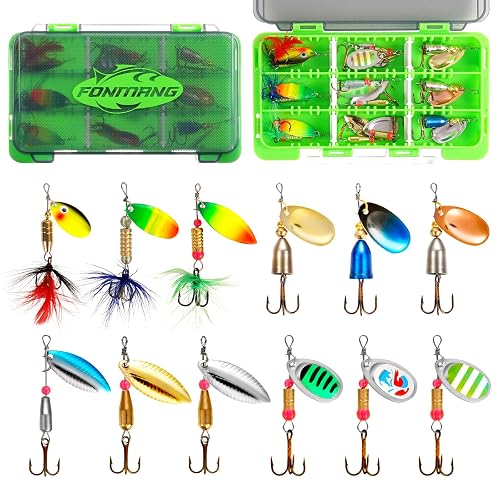
Inline spinners are the workhorse of trout fishing. A spinning blade rotates around a shaft when you reel, creating flash and vibration that trout detect from a distance. They work well in streams and lakes, and they’re easy to fish, even for beginners. Sizes 0 and 1 cover most small-stream situations, while size 2 or 3 gives you more casting distance on lakes. Gold and silver blades with black, brown or chartreuse bodies are reliable starting points.
Small crankbaits and minnow-style plugs
Small diving plugs, usually 1.5 to 2.5 inches long, imitate baitfish and can cover water quickly. They’re especially useful in lakes and tailwaters where trout hold on structure or cruise open water. Use a slow, steady retrieve with occasional pauses so the lip doesn’t bury itself in the bottom. Rainbow, silver and ghost-shad patterns are popular choices.
Soft plastic baits
Soft plastics such as small paddle tails, curly tails and worm-style baits fished on a light jig head or Texas rig are excellent in still water. They sink slowly, which keeps them in the strike zone during cold months. A 1/32 to 1/16 oz jig head matches most trout situations. Fish them on the bottom or just above it with a hop-and-pause retrieve. For more on how these baits behave, see Soft Plastic Fishing Lures Explained.
Spoons
Spoons flutter on the fall and flash on the retrieve, making them effective for trout that are holding deeper or chasing baitfish. A 1/8 to 1/4 oz spoon in gold or silver works in lakes and deeper pools. Let the spoon sink on a slack line for a few seconds after the cast, then retrieve at a steady pace.
How to Choose the Right Lure for Your Situation
With four lure families and dozens of colors, choosing can feel overwhelming. Work through these steps on your next trip.
- Read the surface. Look for rising fish or insect activity. If trout are sipping on top, switch to a small inline spinner or a lightly weighted fly-style presentation.
- Check the depth. If you see no activity, start by fishing the upper third of the water column. If you get no bites after 20 to 30 casts, move deeper with a spoon or a sinking soft plastic.
- Match the color to the water. Use natural tones in clear water and brighter tones in stained water.
- Adjust your retrieve. Start with a steady retrieve, then add pauses or speed changes until you find what trout respond to.
- Change one variable at a time. If you switch lure, color and retrieve together, you won’t know what worked.
Lure sizing guide
| Water type | Lure type | Typical size | Best colors |
|---|---|---|---|
| Small mountain stream | Inline spinner | Size 0 to 1 | Gold, silver, brown |
| Medium river | Inline spinner or small crankbait | Size 1 to 2; 1.5 to 2 in | Chartreuse, natural shad |
| Stocked lake (shore) | Soft plastic on jig head | 1.5 to 2.5 in; 1/32 to 1/16 oz | Pearl, white, watermelon |
| Deep lake or tailwater | Spoon or sinking plug | 1/8 to 1/4 oz | Gold, silver, rainbow |
Best Trout Lures by Season
Seasonal patterns shape which lures get bites. Here’s how to approach the year.
Spring
Spring trout are active and feeding on emerging insects. Small inline spinners and light soft plastics fished slowly along structure are effective. Water is often high and off-color after runoff, so bright colors help.
Summer
Warm water pushes trout into deeper, cooler pockets. Fish early morning or evening, and use spoons or small crankbaits to reach depth. Shade and cooler inflows are good targets.
Fall
Trout feed aggressively as water cools and they prepare to spawn. Larger plugs and spinners get more attention, and the retrieve can be a bit faster.
Winter
Cold-water trout are sluggish. Slow down, fish small soft plastics right on the bottom and expect fewer, more deliberate strikes.
Tips and Common Mistakes
- Using lures that are too big. Trout in small water often refuse oversized baits. Start small and go up only if you’re getting followed without strikes.
- Retrieving too fast in cold water. A slow presentation will outperform a fast one most of the time before water warms.
- Ignoring line size. Light line, about 4 to 6 lb test, gives lures better action and helps in clear water.
- Not checking hooks. Sharp, undamaged hooks matter. Replace dull or rusted ones.
- Fishing one lure too long. If a lure gets no attention after a reasonable test, switch rather than waiting for a miracle.
Recommended gear
A small, organized kit keeps you fishing instead of digging through a tangled box. For storage, a compact Using Utility Boxes for Fishing Lure and Tackle Storage setup works well for trout lures in small compartments.
- Light spinning combo – A 6 to 6.5 foot light-power rod with a small reel lets you cast small inline spinners accurately. View on Amazon
- Fluorocarbon leader line – Low visibility in clear water and good abrasion resistance around rocks. View on Amazon
- Jig head assortment – Keeps you ready for soft plastic fishing at multiple weights. View on Amazon
- Small tackle box or utility box – Compartments keep spinners and plugs separated. View on Amazon
FAQ
What is the single best lure for trout?
There isn’t one universal answer, but a small inline spinner in gold or silver is a dependable first choice in streams and lakes. It works across many seasons and water types.
What color lure should I use for trout?
Use natural colors such as brown, olive or silver in clear water. In stained or murky water, chartreuse, gold and white are easier for trout to see.
What size lure is best for trout?
Most trout respond to lures between 1 and 2.5 inches or equivalent sizes like size 0 to 2 spinners. Smaller is usually better in small streams.
Do trout prefer spinners or soft plastics?
Both work well. Spinners are better for covering water and triggering reaction strikes, while soft plastics excel in still water and cold conditions.
How deep should I fish for trout?
Start in the upper water column and work deeper until you find fish. In summer, trout often hold 10 to 20 feet down in lakes, while in streams they stay near the bottom in deeper pools.
What line should I use with trout lures?
Four to six pound test is common for light trout lures. Fluorocarbon is a good choice in clear water because it’s less visible than monofilament.
Are these lures suitable for beginners?
Yes. Inline spinners and small spoons are among the easiest lures to fish, which makes them a strong starting point for new trout anglers.
Conclusion
The best lures for trout fishing come down to matching the water, the season and the depth you’re fishing. Start with a small set of inline spinners, soft plastics and a spoon, and learn how each one behaves in your local water. Change one variable at a time, keep notes, and you’ll quickly build a box that catches fish.