Quick answer
Our overall pick for a versatile, durable monofilament is the Berkley Trilene XT in a 10-pound test. Other lines on our list are better suited for specific scenarios, like ultralight trout fishing, heavy-duty applications, or situations where low visibility is critical.
Choosing the best fishing line weight is a foundational decision for any angler. The right line strength balances the need to land fish with the need for a natural presentation. This roundup compares seven lines across a wide range of tests and constructions, from ultralight copolymer to heavy-duty braid, based solely on the manufacturer’s listed specifications.
Quick picks
- Best All-Around Monofilament: Berkley Trilene XT Monofilament (see on Amazon)
- Best Ultralight Copolymer: Trout Magnet S.O.S. Copolymer Line (see on Amazon)
- Best Heavy-Duty Kit: Aboda Heavy Duty Monofilament Kit (see on Amazon)
- Best Zero-Stretch Braid: Dorisea Extreme Black Braid (see on Amazon)
7 Best Fishing Line Weight compared
| # | Product | Best for | Material/Type | Break Strength | Spool Length |
|---|---|---|---|---|---|
| 1 | Berkley Trilene XT Monofilament | Best All-Around Monofilament | Monofilament | 10 lb | 300 yd |
| 2 | Trout Magnet S.O.S. Copolymer Line | Best Ultralight Copolymer | Copolymer | 2 lb | 350 yd |
| 3 | Trout Magnet S.O.S. 4 lb Copolymer | Best Lightweight Copolymer for Visibility | Copolymer | 4 lb | 350 yd |
| 4 | Aboda Heavy Duty Monofilament Kit | Best Heavy-Duty Kit with Crimps | Monofilament (Nylon/Fluorocarbon Coated) | 100 lb | 328 ft |
| 5 | Acejoz Heavy Monofilament Craft Line | Best for Crafts and Heavy Hanging | Monofilament (Nylon) | 70 lb | 656 ft |
| 6 | TrikFish Fluorocarbon Leader | Best Fluorocarbon Leader Material | Fluorocarbon Leader | 20 lb (as per title) | 50 yd |
| 7 | Dorisea Extreme Black Braid | Best Zero-Stretch Braid | Braided (PE) | 100 lb | 109 yd |
How we chose
We compared manufacturer listings and specifications on Amazon as of October 2026. We did not perform hands-on testing. Our selections are based on comparing stated features like material, break strength, length, and advertised performance characteristics such as abrasion resistance and visibility.
7 Best Fishing Line Weight: our picks in detail
1. Best All-Around Monofilament: Berkley Trilene XT Monofilament
Pros
- Listed as highly abrasion resistant for heavy cover
- Designed to pair toughness with flexibility
- Available in a wide range of break strengths
Cons
- The listing does not mention its performance in very cold weather
- As a monofilament, it will have some inherent stretch
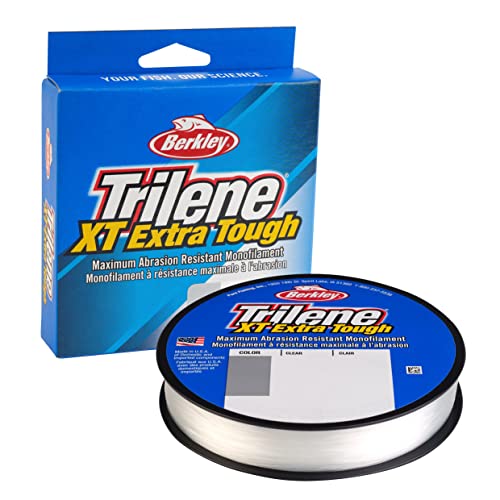
The Berkley Trilene XT is presented as a heavy-duty monofilament fishing line designed for rough conditions. According to the listing, its formula pairs toughness with flexibility, aiming to provide control in various situations. It is offered in a 10-pound test on a 300-yard spool and is described as having ultra abrasion resistance for fishing in heavy cover. The clear color is said to disguise its presence underwater.
The listing states this line is available in a wide range of break strengths from 4 to 30 pounds, with a diameter of 0.014 inches for the 10-pound version.
Best for: Anglers seeking a durable, general-purpose monofilament line for freshwater fishing in varied conditions.
2. Best Ultralight Copolymer: Trout Magnet S.O.S. Copolymer Line

Pros
- Designed for light line fishing with smooth casting
- Listed as extremely abrasion resistant with great knot strength
- Long 350-yard spool for the light test
Cons
- Very light 2-pound test is not suitable for larger fish or heavy cover
- The listing does not mention its UV resistance
The Trout Magnet S.O.S. Fishing Line is a light copolymer line specifically mentioned for trout and panfish on ultralight tackle. The listing promotes its smoothness, abrasion resistance, and knot strength. It is described as being stronger than other lines at the same diameter, which can be a key factor in line selection. The clear color is noted as being hard to see in most water conditions, and it is also said to offer good casting distance and manageability.
This line comes in a 2-pound test on a 350-yard spool.
Best for: Targeting trout and panfish with ultralight tackle where fine diameter and low visibility are priorities.
3. Best Lightweight Copolymer for Visibility: Trout Magnet S.O.S. 4 lb Copolymer
Pros
- Shares the advertised abrasion resistance and knot strength of the S.O.S. line
- Green color may offer an advantage in specific water conditions
- 350-yard spool length
Cons
- 4-pound test still limits use to smaller species
- The listing does not compare its visibility to the clear version
This is a 4-pound test version of the Trout Magnet S.O.S. copolymer fishing line, also offered on a 350-yard spool. It shares the same advertised features as the 2-pound version, including smoothness, toughness, abrasion resistance, and good knot strength. The listing claims it is stronger than other lines of the same diameter. A key difference is its color, listed as green, which the manufacturer states is hard to see in most water conditions.
Like its lighter counterpart, it is presented as a line for trout and panfish on ultralight tackle.
Best for: Anglers who prefer a green-colored line for low visibility in certain water conditions while still using light tackle.
4. Best Heavy-Duty Kit with Crimps: Aboda Heavy Duty Monofilament Kit

Pros
- Comes as a kit with crimp sleeves
- Listed as highly abrasion resistant and strong
- Clear for low visibility and versatile for non-fishing uses
Cons
- 1mm diameter is very thick and not suitable for most casting reels
- The 328-foot length is shorter than typical heavy-duty spools
The Aboda Heavy Duty Fishing Line is a 1mm diameter, 100-pound test monofilament sold as a complete kit. It includes a 328-foot roll of line and 40 crimp sleeves. The line is described as made from nylon with a fluorocarbon coating for strength and wear resistance. The listing states it is designed for high abrasion resistance in demanding conditions and is clear for low visibility underwater.
Beyond fishing, the listing promotes its versatility for crafts, hanging decorations, and other DIY projects. It is noted as being available in multiple diameter options.
Best for: Heavy-duty saltwater applications, trolling, or anglers who also need a strong, clear line for crafting and DIY projects.
5. Best for Crafts and Heavy Hanging: Acejoz Heavy Monofilament Craft Line

Pros
- Very long 656-foot spool
- Listed as strong and durable for heavy hanging
- Easy to knot and described as invisible for crafts
Cons
- Primary marketing is for crafts, not optimized fishing performance
- The listing does not mention its abrasion resistance for fishing
The Acejoz line is a 0.8mm diameter, 70-pound test monofilament marketed primarily for crafts and hanging decorations. The listing emphasizes its strength and durability for supporting up to 70 pounds, noting it is made of clear nylon. It is described as flexible, easy to knot, and practically invisible against light backgrounds.
The spool is a long 656-foot (200-meter) roll, and it is wound on a plastic roller for neat storage. While it is called a fishing line, the listed applications focus on crafting, beading, sewing, and hanging decorations like balloons and pictures.
Best for: Craft projects, hanging decorations, and situations where a strong, clear, and knot-friendly line is needed, with potential for heavy-duty fishing leaders.
6. Best Fluorocarbon Leader Material: TrikFish Fluorocarbon Leader

Pros
- Designed as a leader material with high abrasion resistance
- Promoted as virtually invisible underwater
- Convenient wrist spool format
Cons
- Shorter 50-yard length is typical for leaders, not main line
- Fluorocarbon can be stiffer than other lines
The TrikFish Fluorocarbon Leader is presented as a leader material for both freshwater and saltwater fishing. The listing highlights its extreme strength and abrasion resistance, claiming it can handle rocks, structures, and sharp teeth. Its key advertised feature is being clear and virtually invisible underwater due to reflective characteristics matched to water.
It comes on a convenient 50-yard wrist spool and is available in tests from 15 to 100 pounds. The manufacturer emphasizes its use for making stealthy presentations where line visibility is a critical concern.
Best for: Anglers who need a tough, abrasion-resistant, and nearly invisible leader for clear water or wary fish.
7. Best Zero-Stretch Braid: Dorisea Extreme Black Braid
Pros
- Constructed for high sensitivity with near-zero stretch
- Advertised as having superior abrasion resistance
- Black color is promoted as fade-proof and non-transferring
Cons
- Braided line is highly visible and often requires a leader
- 109-yard spool is relatively short for a braided main line
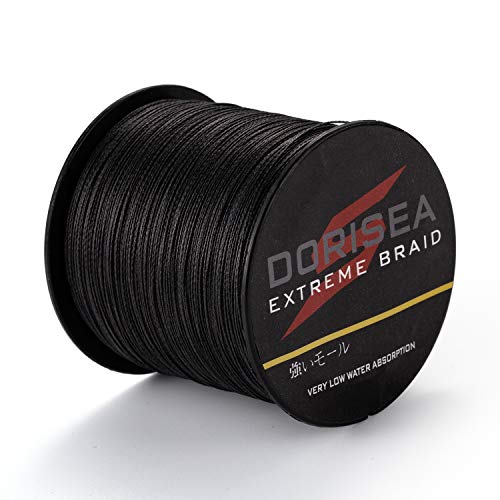
The Dorisea Extreme Braid is a 100% polyethylene (PE) braided fishing line. The listing promotes its ultra-strong construction from four strands of high-molecular-weight polyethylene, resulting in near-zero stretch and high sensitivity to detect light bites. It is also described as having superior abrasion resistance, low memory, and a thin diameter for its 100-pound test strength.
A notable feature is the claim of “never-color-fading” black dye that won’t transfer to hands or clothes. The specific option listed is a 0.55mm diameter, 100-pound test on a 109-yard (100-meter) spool.
Best for: Anglers seeking maximum sensitivity, hook-setting power with minimal stretch, and a durable braid for heavy-duty applications.
How to choose the best fishing line weight
The right fishing line weight acts as the critical link between you and the fish. It’s not just about raw strength; factors like diameter, visibility, and material behavior in water are equally important. A line that’s too heavy can spook fish in clear water, while a line that’s too light may break when you need it most. Your choice should start with the species you’re targeting and the environment you’re fishing in.
For more on how different materials behave, see our article on Fishing Line Stretch. The diameter of your line directly affects casting distance and how naturally your lure or bait can move; learn more in our guide to Fishing Line Diameter. Finally, managing what the fish sees is crucial, and we cover strategies in Managing Fishing Line Visibility.
What to look for
- Break Strength: Match the line’s pound test to the average size of your target fish and the obstacles (like rocks or wood) you’ll encounter. Our Fishing Line Strength Guide can help.
- Material: Monofilament is forgiving and buoyant, fluorocarbon is nearly invisible and sinks, braid is strong and sensitive with little stretch. Each has its place.
- Spool Length: Ensure you have enough line to fill your reel properly, with some extra for re-spooling after wear or break-offs.
- Advertised Features: Look for claims that match your needs, such as abrasion resistance for rocky bottoms, low visibility for clear water, or specific knot strength.
FAQ
What does “pound test” mean?
The pound test of a fishing line refers to the amount of weight, in pounds, that the line can theoretically hold before breaking under a steady, straight pull in controlled conditions. It’s a primary indicator of line strength.
Should I always use the lightest line possible?
Not necessarily. While lighter line can be less visible and allow lures to move more naturally, you must balance this with the need for enough strength to handle the fish, its fight, and any structure in the water. Abrasion from rocks, wood, or a fish’s teeth can weaken lighter lines quickly.
What is the difference between main line and leader line?
Main line is what you spool onto your reel. A leader is a separate, usually shorter, section of line tied between the main line and the lure or hook. Leaders are often made of a different material, like fluorocarbon for invisibility or wire for toothy fish, to provide specific advantages without spooling your entire reel with that specialty line.
How often should I replace my fishing line?
Fishing line degrades over time due to UV exposure, abrasion, and memory (coiling). There’s no single rule, but inspect your line regularly for nicks, frays, or changes in color and texture. Many anglers replace monofilament and fluorocarbon once a season if used frequently, while braid can last multiple seasons. Always re-tie knots after landing a good-sized fish or if you suspect any damage.
References
- Amazon product listings and manufacturer specifications (accessed October 2026)
- Take Me Fishing for general angling knowledge
- International Game Fish Association (IGFA)